
Monocrystalline Silicon (Mono-Si) Panels
Monocrystalline panels are produced from a single continuous silicon crystal, grown using the Czochralski process. A cylindrical silicon ingot is sliced into wafers, which are then processed into cells. Because the crystal structure is uniform throughout, charge carriers face fewer lattice defects when moving through the material. This translates into higher conversion efficiency compared to other silicon technologies.
Efficiency and Output
Standard residential mono-Si modules commercially available in Germany typically achieve module efficiencies between 20% and 23%, with some premium products exceeding this range under standard test conditions (STC: 1,000 W/m², 25°C, AM 1.5 spectrum). Manufacturers publish peak wattage (Wp) figures on the module datasheet; a 400 Wp module occupies roughly 1.7–1.9 m² of roof area.
The temperature coefficient of mono-Si panels typically falls between −0.30% and −0.40%/°C. In practical terms, panel surface temperatures in summer can reach 50–65°C, which reduces output compared to STC ratings. A module with a −0.35%/°C coefficient operating at 60°C loses approximately 12.25% of rated output compared to its STC value.
Visual Appearance and Format
Mono-Si cells have a near-uniform dark blue or black appearance due to the anti-reflective coating applied to the silicon surface. The distinctive rounded corners visible on individual cells result from the cylindrical ingot shape. Modules are available in 60-cell (roughly 1.0 × 1.65 m), 72-cell, and larger half-cut or bifacial configurations. Half-cut cell technology splits each cell horizontally, reducing internal resistance and improving performance under partial shading.
Degradation and Lifespan
Most manufacturers provide a linear power output warranty covering 25 or 30 years, guaranteeing a minimum output — commonly 80–87% of initial rated power — at the warranty end date. Annual degradation rates for mono-Si are typically cited at 0.3–0.5% per year. Light-induced degradation (LID) is a known phenomenon in conventional boron-doped p-type cells, which causes a temporary output reduction of 1–3% within the first hours of sunlight exposure. Gallium-doped and n-type mono-Si cells are less susceptible to LID.
Crystalline silicon PV modules intended for sale in Europe are tested under IEC 61215 (Terrestrial photovoltaic modules — Design qualification and type approval). This standard covers thermal cycling, humidity freeze, damp heat, and mechanical load tests. Compliance is demonstrated through certification by an accredited laboratory.
Polycrystalline Silicon (Poly-Si / Multi-Si) Panels
Polycrystalline panels are manufactured from silicon cast in square moulds rather than grown as a single crystal. The casting process is less energy-intensive than the Czochralski method, which historically contributed to lower production costs per watt. The resulting ingot contains multiple crystal grains oriented in different directions, and the visible boundaries between these grains give the cells their characteristic speckled blue appearance.
Efficiency Range and Market Position
Module efficiencies for standard poly-Si products typically range from 15% to 18%. The lower efficiency means more roof area is required to achieve the same peak capacity compared to mono-Si. Given that European residential roofs average 80–120 m² of usable south-facing area, this distinction is relevant when roof space is constrained.
The price differential between poly-Si and mono-Si has narrowed considerably as diamond-wire sawing improved mono-Si wafer production economics. For many installers, mono-Si modules now represent the default choice based on price-per-watt comparisons, with poly-Si playing a reduced role in new residential installations.
Performance Under Real Conditions
Poly-Si panels have a slightly less favourable temperature coefficient than mono-Si, typically in the −0.40% to −0.45%/°C range. Under diffuse irradiation — the overcast conditions common across central and northern Germany — both technologies perform comparably, since low-irradiance efficiency depends on different cell parameters than peak efficiency.
Thin-Film Technologies
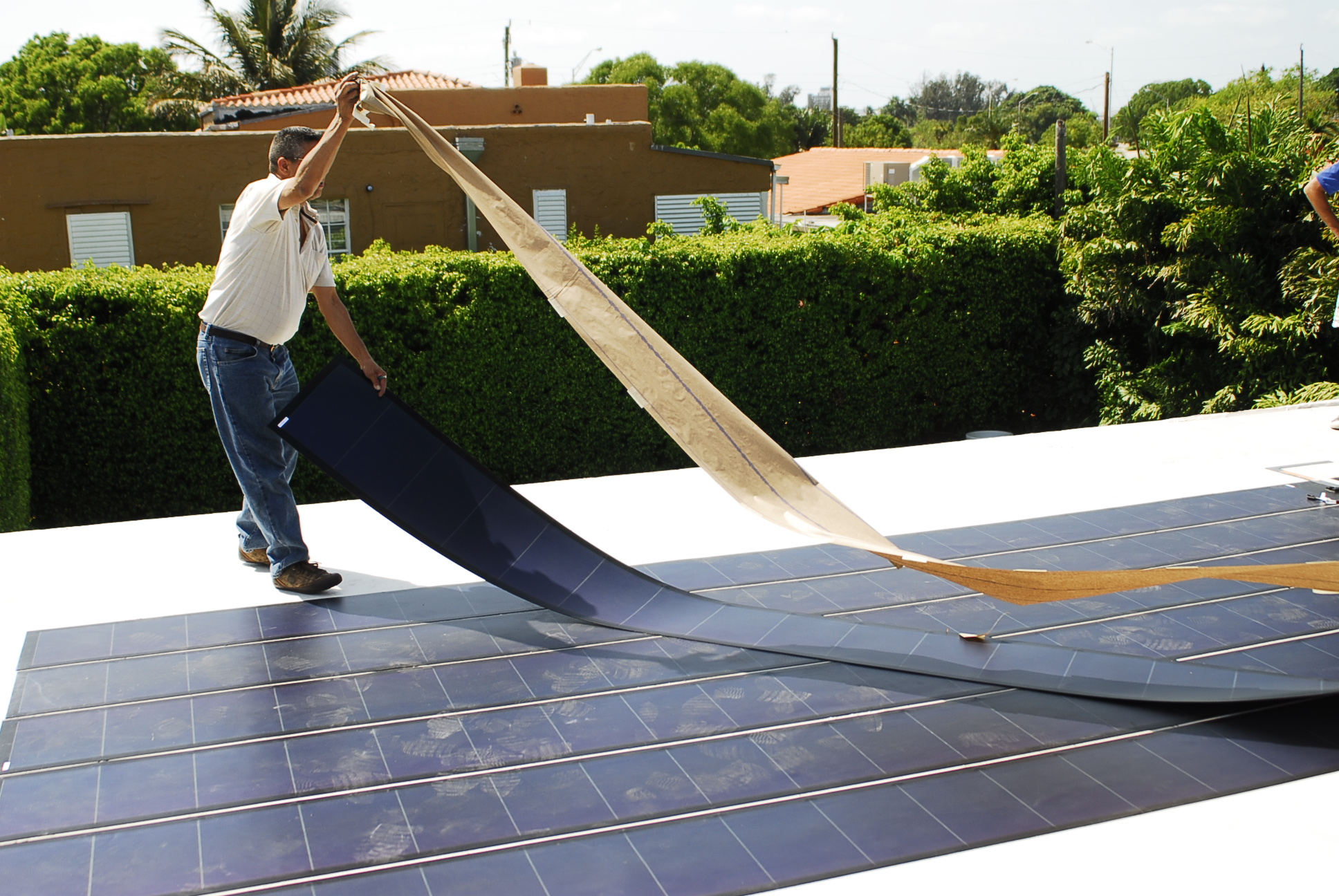
Thin-film solar cells deposit light-absorbing semiconductor material in layers only a few micrometres thick onto a substrate (glass, metal foil, or polymer film). The reduced material requirements lower production costs per unit area, though the lower efficiency of most thin-film products means more surface area is needed per kilowatt-peak. Three technologies are commercially relevant for residential applications.
Amorphous Silicon (a-Si)
Amorphous silicon cells lack the long-range crystal structure of their wafer-based counterparts. Typical module efficiencies are 6–8%, though stabilised efficiencies after initial light-induced degradation (the Staebler-Wronski effect) are lower than initial values. The advantage of a-Si lies in its broad spectral response, which extends into the blue-green range, giving it relatively better performance under diffuse light and indoor lighting conditions. Building-integrated applications (e.g., semi-transparent façade modules) represent a typical niche for a-Si.
Cadmium Telluride (CdTe)
CdTe thin-film is the most commercially successful thin-film technology globally. Module efficiencies in the range of 16–19% are achieved by large-scale manufacturers. CdTe cells have a temperature coefficient typically around −0.28%/°C, which compares favourably to crystalline silicon. The primary concern for residential installers and end-of-life planning is the cadmium content; CdTe modules must be disposed of through manufacturer take-back programmes under WEEE directive requirements.
Copper Indium Gallium Selenide (CIGS)
CIGS cells achieve module efficiencies of 14–17% for commercial products, with laboratory cells exceeding 22%. The flexible substrate options available with CIGS make it relevant for non-standard installation surfaces. The technology contains indium and gallium, the supply chains for which are more constrained than silicon. CIGS retains good performance at low irradiance levels.
Choosing a Technology for German Roof Conditions
German residential rooftops present specific conditions that influence technology selection. Mean annual global horizontal irradiation varies from roughly 1,000 kWh/m² in the north (Schleswig-Holstein) to over 1,200 kWh/m² in Bavaria. Overcast periods are frequent from October through February, making low-irradiance performance relevant throughout the year.
For most pitched-roof installations with adequate south-facing area, monocrystalline silicon currently represents the most common commercial choice. The combination of high efficiency, proven long-term degradation data, widespread manufacturer warranties, and competitive installed cost makes it practical for 5–15 kWp residential systems.
Roof space constraints — partial shading from chimneys, dormers, or adjacent buildings — may make half-cut mono-Si or bifacial modules worth considering, as these technologies reduce mismatch losses. Thin-film modules are encountered primarily in facade or flat-roof integration scenarios where their form factor or weight characteristics provide specific advantages.
| Property | Mono-Si | Poly-Si | Thin-Film (CdTe) |
|---|---|---|---|
| Module efficiency (typical) | 20–23% | 15–18% | 16–19% |
| Temperature coefficient | −0.30 to −0.40%/°C | −0.40 to −0.45%/°C | approx. −0.28%/°C |
| Low-irradiance performance | Good | Good | Very good |
| Typical appearance | Uniform dark blue/black | Speckled blue | Uniform dark (opaque) or semi-transparent |
| Key standard | IEC 61215 | IEC 61215 | IEC 61646 |
| Warranty period (typical) | 25–30 years | 25 years | 25 years |